

Pea Protein Market to Reach USD 6.63 Billion by 2032 at 13.97% CAGR: Clean-Label and Plant-Based Demand Driving Growth
Pea Protein Market graph
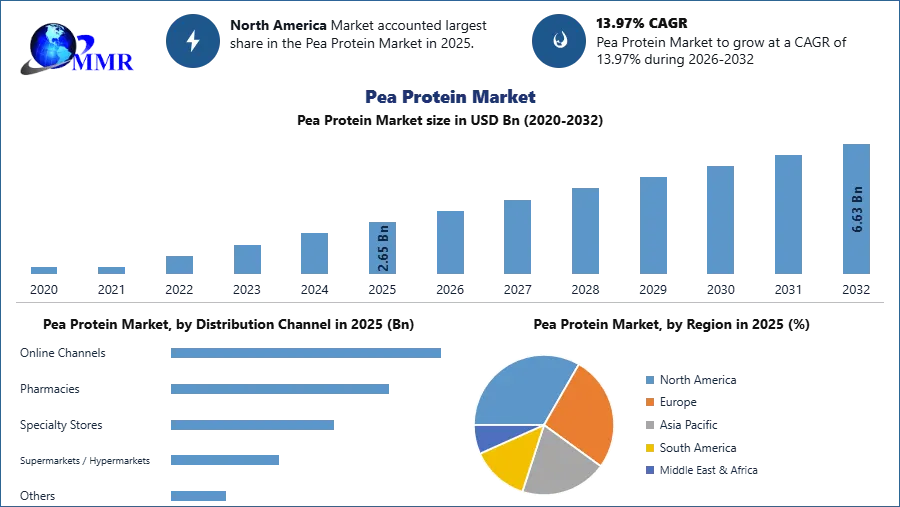
The Pea Protein Market was valued at USD 2.65 billion in 2025 and is projected to reach USD 6.63 billion by 2032, growing at a CAGR of 13.97%.
"Solving the 'Taste-Texture Gap' is the trillion-dollar key to unlocking mainstream plant-based adoption," according to Maximize Market Research.”
ROCKVILLE , MD, UNITED STATES, March 26, 2026 /EINPresswire.com/ -- A new strategic study by Maximize Market Research has identified a fundamental shift in the Pea Protein Market, which is now forecast to grow from USD 2.65 Billion in 2025 to USD 6.63 Billion by 2032. Unlike previous growth cycles driven by meat-substitution, the current 13.97% CAGR is being fueled by a Technical Reset in ingredient purity. Our analysis reveals that Membrane Filtration technology is successfully removing the bitter off-notes that previously limited pea protein's use in dairy and sports nutrition. The focus has shifted to Supply Sovereignty, with manufacturers bypasssing global trade volatility by co-locating processing plants directly within yellow pea production hubs.— Maximize Market Research
Get Full PDF Sample Copy of Report: (Including Full TOC, List of Tables & Figures, Chart) @ https://www.maximizemarketresearch.com/request-sample/26472/
Pea Protein Market Dynamics: Why Supply Sovereignty is Fueling a 13.97% CAGR
The momentum of the Pea Protein Market is currently dictated by a "Supply Sovereignty" shift as global processors bypass traditional trade volatility. While Canada’s 2025-26 pea harvest surged by 31% to 3.9 million tonnes, market leaders are increasingly prioritizing vertical integration within "Yellow Pea Belts" to mitigate a 22% spike in spot prices seen during previous drought cycles.
Technically, the industry is undergoing an "Organoleptic Reset." Standard alkaline extraction is being phased out for ultrafiltration-driven refinement, which successfully isolates globulins while reducing bitter saponins by up to 68%. This allows for 90%+ protein purity, solving the flavor hurdles that previously hindered dairy and sports nutrition applications. This revenue velocity is further accelerated by the "Clean Label 2.0" movement, where pea protein is favored for its low-allergen status and a carbon footprint 90% lower than beef protein, positioning it as the premier architectural ingredient for sustainable F&B portfolios.
Key Trends Redefining the Pea Protein Landscape
GLP-1 Supportive Nutrition: Formulators are leveraging high-purity pea isolates to create nutrient-dense, small-portion meals specifically designed for patients on GLP-1 therapies, prioritizing muscle mass maintenance through rapid amino acid absorption.
The Rise of Hybrid Balanced Proteins: A significant shift is occurring toward Blended Meats, where pea protein is combined with animal proteins to reduce carbon footprints while maintaining the sensory familiarity required by flexitarian consumers.
Bioactive Peptide Discovery: Advanced enzymatic hydrolysis is being utilized to unlock specific bioactive peptides within yellow peas, targeting Condition-Specific markets such as anti-hypertensive supplements and hypoallergenic infant formulas for the medical nutrition sector.
Pea Protein Market Regional Analysis: The Rise of Crush-at-Source Infrastructure in Canada and APAC
The geography of high-purity protein production is undergoing a radical decentralization. While North America maintained a dominant 38.4% share in 2025, the focus has pivoted to the Canadian Prairie Provinces, where massive capital expenditure is being funneled into co-located fractionation facilities. This strategy reduces trans-continental logistics costs by 18%, insulating regional supply chains against global fuel volatility.
Simultaneously, the Asia-Pacific (APAC) region has emerged as a high-velocity frontier. Driven by India’s Production Linked Incentive (PLI) scheme and China’s aggressive investment in high-moisture extrusion (HME) technology, these markets are transitioning from raw material importers to specialized isolate exporters. In Europe, the EU’s Farm to Fork 2.0 mandate is incentivizing French and Russian cultivation, creating a self-sustaining Protein Sovereignty corridor that bypasses traditional chokepoints in global trade.
Functional Segmentation: Decoding the 43.8% Share of Isolates in Performance Nutrition
The structural evolution of the industry is defined by the move toward specialized functionality. Pea Protein Isolates dominate the landscape with a 43.8% share, favored for their 90% protein concentration and superior emulsification in performance nutrition and dairy-free beverages. Meanwhile, Textured Pea Protein (TPP) is emerging as the highest-growth segment, driven by High-Moisture Extrusion (HME) technologies that allow for the fibrous "bite" required in premium meat analogues.
From an application perspective, while Food & Beverages remain the largest revenue pillar, the Dietary Supplements sector is expanding rapidly. This is fueled by the Clean Label 2.0 wave, where consumers prioritize hypoallergenic, non-GMO profiles. Additionally, Pea Protein Concentrates are seeing a resurgence in the bakery and snack segments, offering a cost-effective, fiber-rich solution for mass-market protein fortification without compromising on clean-label transparency.
Get Full PDF Sample Copy of Report: (Including Full TOC, List of Tables & Figures, Chart) @ https://www.maximizemarketresearch.com/request-sample/26472/
By Type
Isolates
Concentrates
Textured
By Form
Dry
Wet
By Source
Split yellow peas
Lentils
Chickpeas
Others
By Application
Animal Feed
Bakery Goods
Beverages
Dietary Supplements
Infant Nutrition
Meat Substitutes
Personal Cosmetics
Others
By Distribution Channel
Online Channels
Pharmacies
Specialty Stores
Supermarkets / Hypermarkets
Others
Expert Verdict: The Organoleptic Reset and the Path to 2032 Valuation
The sector has officially transitioned from an adoption phase into a technical refinement era, The primary competitive moat is no longer sheer volume, but Organoleptic Parity the engineering ability for plant-derived isolates to be indistinguishable from animal proteins in neutral flavor profiles and mouthfeel.
This shift toward membrane filtration and enzymatic debittering is the core engine behind the projected USD 6.63 Billion valuation. By eliminating the earthy off-notes traditionally associated with pulses, manufacturers are unlocking high-margin opportunities in the performance nutrition and clinical health verticals. For stakeholders, the real long-term alpha lies in the intellectual property surrounding low-sodium extraction and clean-label functionality, which will dictate market leadership through the end of the forecast period.
Pea Protein Market, Key players
DuPont
Ingredion
Puris
The Scoular Company
Burcon
AGT Food and Ingredients
Axiom Foods, Inc.
Roquette Frères
Cosucra Groupe Warcoing
Emsland Group
Glanbia PLC
Kerry
Yantai Shuangta Foods Co
Shandong Jianyuan Group
ET-Chem
Get access to the full description of the report @ https://www.maximizemarketresearch.com/market-report/global-pea-protein-market/26472/
FAQ’s
What drives the projected USD 6.63 Billion valuation?
Ans: The surge is anchored in the 'Clean Label 2.0' movement. Beyond simple veganism, the demand for hypoallergenic, non-GMO, and low-carbon-footprint ingredients has positioned yellow pea derivatives as the premier choice for global F&B reformulations.
How do new extraction technologies impact flavor?
Ans: Advanced ultrafiltration and enzymatic debittering are now industry standards. These methods remove bitter saponins and phytic acid, achieving 90% purity levels that meet the sensory requirements of performance nutrition and dairy-alternative sectors.
Why is the Asia-Pacific region a high-velocity frontier?
Ans: Growth is fueled by localized infrastructure. Supported by India’s PLI scheme, the region is transitioning from a raw material importer to a dominant exporter of value-added isolates.
Which technical segment leads in innovation?
Ans: Textured Pea Protein (TPP) is the frontrunner. Utilizing High-Moisture Extrusion (HME), this segment solves the "fibrous bite" challenge, allowing plant-based meat analogues to achieve structural parity with animal proteins.
Related Reports
Plant-Based Food & Beverage Market: http://maximizemarketresearch.com/market-report/plant-based-food-beverage-market/111733/
Vegan Food Market: https://www.maximizemarketresearch.com/market-report/vegan-food-market/123528/
Plant-based Meat Market: https://www.maximizemarketresearch.com/market-report/global-plant-based-meat-market/52808/
Sports Nutrition Market: https://www.maximizemarketresearch.com/market-report/sports-nutrition-market/21164/
Functional Drinks Market: https://www.maximizemarketresearch.com/market-report/functional-drinks-market/189755/
Top Reports:
Global Knitwear Market
Global Ion Implantation Machine Market
About Maximize Market Research
Maximize Market Research is a global business intelligence firm empowering Fortune 500 companies across 45 countries. We provide high-impact, data-driven strategic intelligence to navigate industrial shifts and secure market dominance through actionable growth roadmaps and deep-tier competitive analysis.
Domain Focus: Food & Beverages
Our research deciphers the global transition toward Clean Label 2.0 and Functional Nutrition. We analyze the intersection of membrane filtration and high-moisture extrusion, evaluating high-purity protein isolates to identify emerging plant-based valuation trends.
Lumawant Godage
MAXIMIZE MARKET RESEARCH PVT. LTD.
+ +91 96073 65656
email us here
Visit us on social media:
LinkedIn
Instagram
Facebook
X
Legal Disclaimer:
EIN Presswire provides this news content "as is" without warranty of any kind. We do not accept any responsibility or liability for the accuracy, content, images, videos, licenses, completeness, legality, or reliability of the information contained in this article. If you have any complaints or copyright issues related to this article, kindly contact the author above.
